
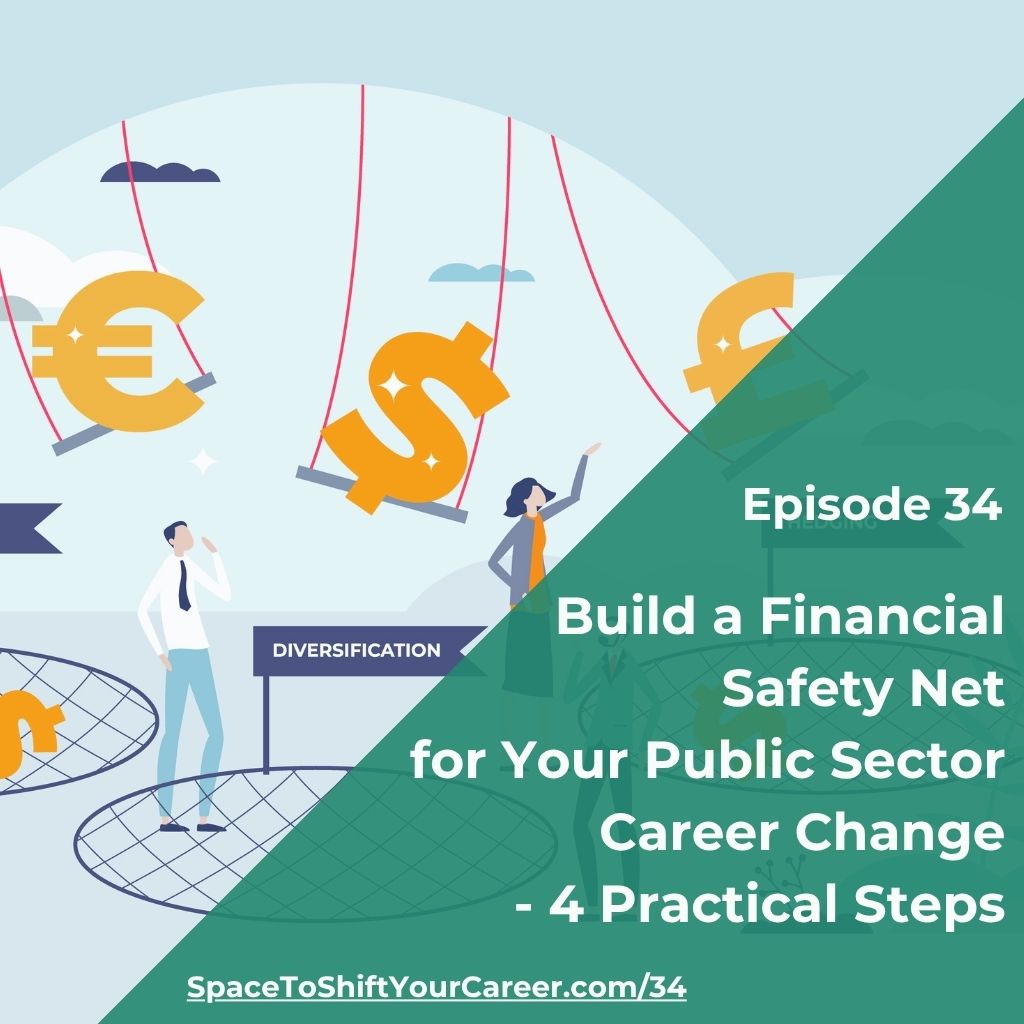
Imagine you’re a trapeze artist learning a new routine. You wouldn’t practise without a net below you. The net doesn’t make the act less brave. It makes it possible.
In the public sector, you’ve likely been performing with a net you didn’t have to build all by yourself. Your employer provided it: steady salary, predictable benefits, pension contributions.
It’s worked well. Until now. When you’re considering a new move, whether that’s because you’re forced to or by choice.
It requires you to build your own safety net. And that can feel daunting, especially when you’ve never had to do it before.
Building your own financial safety net is about having enough clarity and preparation that you can explore your next act – without panic.
And: it’s about taking back agency.
In this episode, I’ll share 4 practical steps to help you build that net, so you can move forward prepared and more confidently.
Disclaimer: Please note, I am not giving you specific financial advice. Once you’ve done a first stock take, I encourage you to seek out a professional financial advisor to help you make decisions suitable for your specific situation.
Why Financial Planning Matters For Your Public Sector Career Change
The number one fear public sector leaders have about career change is financial security. I talked about this in Episode 7 called “The #1 Fear Public Sector Leaders Have About Shifting Careers”. And it makes complete sense.
You’ve built your life around a certain level of income and benefits. People depend on you. You have responsibilities.
So when you consider leaving, the financial questions loom large:
“Can I actually afford this?”
“What if I run out of money?”
“What about my pension? My health insurance? My leave entitlements?”
These are real, practical considerations that deserve serious attention.
And here’s what I’ve noticed: Many leaders let these questions stop them before they’ve even looked at the actual numbers. The fear stays vague. And vague fears are more paralysing than specific ones.
So today, I want to help you get specific. To build your own financial safety net so you can make decisions from clarity.
Here are…
4 Practical Steps Public Sector Leaders Can Take Now to Build a Financial Safety Net
Step 1: Know Your Real Numbers
The first step is to understand what you actually need.
Sit down and look at your finances honestly: What do you earn after tax each month?
Where does that money actually go?
- Fixed costs: mortgage or rent, utilities, insurance
- Essential living: food, transport, basic needs
- Discretionary spending: dining out, subscriptions, entertainment
- Savings and investments
What’s your absolute minimum? The amount you need to cover essential costs if everything else stopped.
When you do this exercise you might discover something eye-opening. You might think you need your full salary to survive.
But when you actually track your spending, you may find your essential costs are likely to be less than your current income.
The rest might be lifestyle choices you enjoy or additional savings or investments you could adjust if you had to. Or if you decide to create a different career and life for yourself.
That realisation might change something for you. Suddenly, the financial risk might feel much more manageable.
But, depending on your situation, you might also discover that it is less manageable.
Either way, it’s important information to understand what your options are.
Step 2: Research What You’d Actually Lose
Next, get specific about what leaving would mean for your benefits and entitlements.
- Pension: How much have you accrued? When does it vest? What happens if you leave now versus in a few years?
- Health insurance: What would private cover cost? Are there different tiers or options?
- Leave entitlements: What accumulated leave would you lose? Could you take it as a payout?
- Other benefits: Professional development budgets? Flexible working arrangements? Anything else you value?
Knowing the real cost gives you power.
One leader knew that her pension wouldn’t fully vest for another three years. But the difference between leaving now versus waiting was about only $15,000 total – significant, yes, but far from the deal-breaker she’d imagined.
Another found that private health insurance would cost about $180 a month. Factored into his budget, it was workable.
When you know the actual numbers, you can make an informed choice.
Step 3: Build Your Financial Runway
This is about creating a buffer. How much do you need to feel safe while you transition?
Some people aim for 3-6 months of expenses. Others want a year. There’s no single right answer. It depends on your circumstances, the local market you’re in, and your risk tolerance.
Start building your buffer NOW.
Even if you’re not ready to leave tomorrow, having a buffer gives you options. You’re choosing to stay – for now – while you prepare.
This might look like:
- Cutting back on discretionary spending: Given the high cost of living in many countries, you’ve probably already thought about this. Do you really use that subscription? How often do you need to get a take-away coffee, buy lunch or go out for dinner? All these little things add up.
- Putting bigger expenses on hold: were you planning to renovate the kitchen or replace your car? Can these things wait until you are on the other side of your career transition? Or until you have a better sense of how long it will take and your financial situation?
- Putting bonuses or pay rises (if you’re lucky enough to get them) straight into savings. If you’ve had a pay freeze for 10 plus years and bonuses don’t exist, is there a percentage of your salary you can put into savings straight away the day after you get paid?
- Taking on a small side project to build extra income. If you already work full-time and have caring responsibilities, you might not have time to do this because you are time poor. But if you have the chance to start something small on the side, now is the time to do it and test it.
One of my clients started doing some consulting on the side while still in her government role. By the time she was ready to transition, she had both savings AND a small client base to build from.
Step 4: Consider Bridge Income Options
Career change doesn’t have to mean going from full-time to zero overnight.
There are bridging options:
- Part-time work while you build something new
- Contract or project-based roles
- Consulting in your area of expertise
- A role in a different sector that maintains income while you explore
The goal is to give yourself breathing room while you figure out what’s next.
One of my clients took a similar role in an NGO – slightly lower pay, but stable enough to live on and continue saving. That bought her time and headspace to explore what she really wanted long-term, without financial panic.
You’re Taking Back Agency
Building your own financial safety net is about taking back agency.
In the public sector, the organisation covers a lot of the financial risk for you. Now, you’re learning to cover it yourself. That requires different skills: planning, preparing, being intentional about money.
Once you build that net?
You’re no longer dependent on one single employer for your security. You become resilient in a different way.
Your Next Step
So here’s what I invite you to do this week: Run the numbers.
Sit down with your actual finances and answer:
- What do I need each month to cover essentials?
- What would I actually lose if I left: pension, benefits, entitlements?
- How much of a buffer would I need to feel safe exploring a change?
This is about replacing vague fear with real information.
When you know your numbers, you know what you are dealing with. You can plan. And when you can plan, fear loses its grip.
Until next time: make space, rediscover YOU, and then take action.