
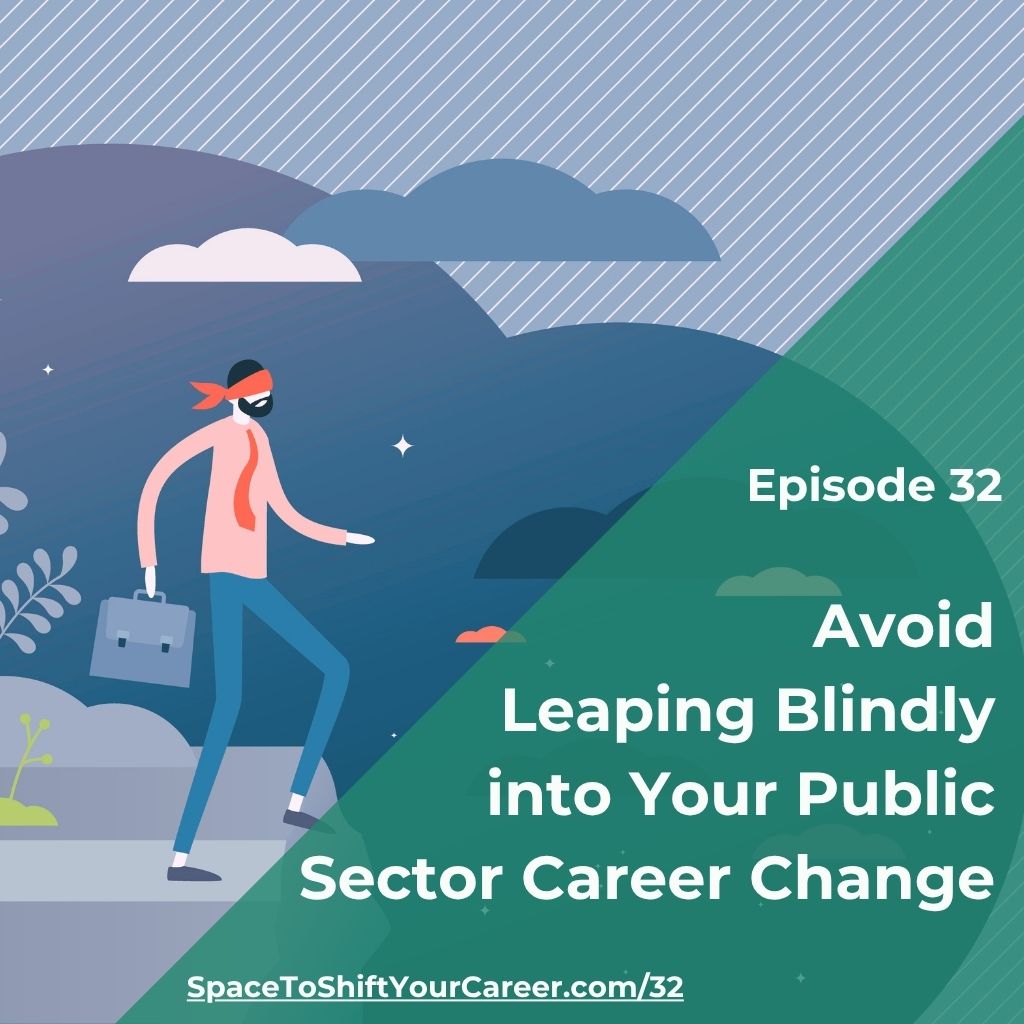
When public sector leaders think about career change, they often picture a leap. A big, bold, all-or-nothing move.
They imagine it’s about leaving everything behind… and hoping the next thing works out. And that image can feel risky and scary.
Because…
What if it doesn’t work?
What if you lose what you’ve built?
What if you make the wrong decision?
So instead of moving… you stay where you are. Because it feels safer.
But career change doesn’t have to be a blind leap.
In fact, when you build a smart career transition strategy, it is a series of small, manageable and deliberate steps.
In this episode of the Space To Shift Your Career podcast, I share 3 ways to manage the risks that come with changing careers. Have a listen and find out how to avoid leaping blindly.
The Choice for Public Sector Leaders is Not ‘Risk or No-Risk’
Most public sector leaders I work with aren’t afraid of change itself. They have navigated a fair share of change in their career!
They’re afraid of losing financial stability, damaging their reputation, or closing doors.
In other words: It’s not change itself that feels risky. It’s the unknown consequences of that change.
So the question is not about how to avoid risk. It is about how you manage risk in a way that allows you to move forward.
As a public sector leader, you do this a lot in your work. You have risk registers for big programmes and change processes.
I actually have an entire episode on how this risk culture impacts your approach to changing careers. Check it out, it’s episode 11 called ‘Has The Public Sector Warped Your Personal Approach to Risk’.
Today I want to share with you…
3 Practical Ways to Manage The Risks That Come With Changing Your Public Sector Career
So here’s…
Way #1: Reduce Uncertainty Through Real-World Insight
The first way to manage risk is to replace assumptions with information.
A lot of the risk we perceive comes from what we don’t know.
What is that role I’m interested in actually like?
Would I even enjoy working in that environment?
What would I need to transition?
When those questions stay unanswered, your brain fills the gaps. Usually with worst-case scenarios.
So to navigate this risk, I invite you to: Go and find out!
Talk to people doing the work. Ask about their day-to-day reality. Understand the challenges, not just the highlights.
This does two things: one, it reduces uncertainty; and two, it helps you make decisions based on reality, not assumptions or fear.
Way #2: Test Before You Commit
The second way to manage risk is to experiment.
You don’t have to make a full decision upfront.
You can explore an idea through conversations. Take on a small project or collaboration. Learn something new related to a different career path.
Think of this as creating low-risk experiments.
Instead of asking “Is this the right move?” And building up pressure. Take a lighter approach and ask yourself: “What can I learn from trying this out?”
Because every small step gives you data about what you enjoy, what fits and what doesn’t.
And over time, those small insights build clarity. A clearer picture about what you could turn into a sustainable solution.
Way #3: Strengthen your foundations
The third way to manage risk is to support yourself properly.
Because risk doesn’t just exist externally – it’s also internal.
So ask yourself:
- What financial stability do I need? To keep paying my expenses? To feel safe?
- Who can support me to figure this out? Both, practically and emotionally?
- What routines or practices help me stay grounded when my head starts spinning?
This might look like: building a financial buffer, having honest conversations with people you trust, and being intentional and deliberate with your time – what and who you prioritise – and how you manage your own mind.
When your foundations are strong, you can handle uncertainty much more effectively.
Which Risk Are Public Sector Leaders More Willing to Take?
Risk doesn’t disappear when you stay where you are. But it changes form.
There is also risk in staying in a role that no longer fits: ignoring what actually matters to you now, or in delaying change for years, especially when you know deep down that something needs to change for you.
So it’s not about choosing ‘risk or no risk’. It’s about choosing WHICH RISK are you more willing to take?
If you’re wondering where to start, I invite you to ask yourself:
– Where am I currently over-estimating risk because I lack information?
– And what’s one step I could take to reduce that uncertainty?
Career change will always involve some level of risk. But it doesn’t have to be reckless.
With the right approach and a smart transition strategy, it can be thoughtful, gradual, and grounded.
And that’s what allows you to move forward – without leaping blindly.
Until next time: make space, rediscover YOU, and then take action.