
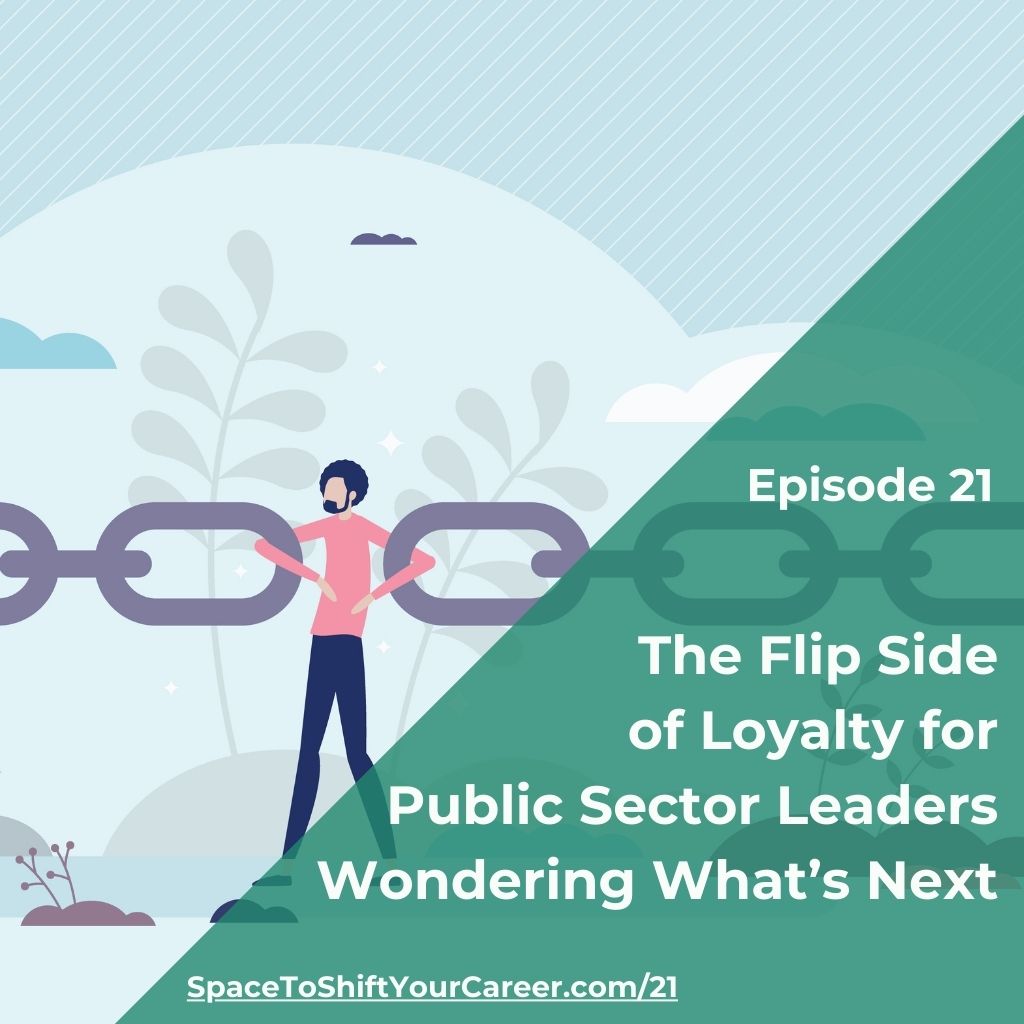
Many public sector leaders feel guilty for wanting something different, even when their work no longer lights them up.
They stay in roles not because they still love them. But because they feel loyal.
Loyal to the mission. Loyal to their team. Loyal to the public sector.
What if loyalty isn’t just something you owe your organisation, but something you owe yourself?
In episode 21 of the Space To Shift Your Career podcast, we explore the flip side of loyalty.
And why being loyal to yourself might be the most important leadership decision you make.
Loyalty’s Hidden Cost
Many public sector leaders I work with entered the sector because they wanted to make a positive difference. Service, impact, contribution. That mattered deeply.
So when their work no longer lights them up, when they feel plateaued, under-utilised, or a little bored, it can feel almost like betrayal to even think about leaving.
There’s loyalty to the mission, to the organisation, to colleagues and teams.
There’s loyalty to family and friends who may not understand why you’d want to give up what looks like a secure, meaningful career.
And so leaders stay. They stay loyal – to everyone except themselves.
Loyalty Has Multiple Directions
What if loyalty isn’t only something you owe outward?
What if it also points inward. Towards your values. Your energy. Your growth. Your future self.
Many leaders have been taught to be loyal to systems and structures. To their profession and sector. To society. To their country.
But they’ve never been taught how to be loyal to their own evolving selves.
The paradox is: when you abandon yourself for too long, your impact often shrinks. You’re still there – but less alive.
The Reciprocity Myth
There’s also an unspoken assumption that if you stay loyal, the system will stay loyal to you.
But political winds change. Priorities shift. Budgets get cut. Organisations are redesigned.
It’s rarely personal. But it is real.
You might be giving everything to a system that, by design, cannot give you the same loyalty back.
That doesn’t make it wrong.
But it does mean you need to be intentional about where you place your loyalty.
Let me offer you a few reflections:
- What did you think when a respected colleague left? How did things unfold a year later?
- Who has supported your career most? How might they respond if you shared what’s really going on for you?
- Where might you be confusing loyalty with obligation or fear?
Loyalty is a strength. But when overplayed, it can hold you back.
How Public Sector Leaders Can Navigate the Loyalty Question on Their Career Change Journey
You don’t need to resign tomorrow or burn bridges. You can honour your loyalty while exploring what’s next.
That might mean doing the maths, testing ideas, exploring possibilities behind the scenes. AND talking with your inner circle in a thoughtful way – when you are prepared and ready.
Many leaders are surprised by how supportive people actually are. Because those who care about you want to see you fulfilled, not depleted.
Loyalty is a beautiful quality. But you are also allowed to be loyal to YOURSELF.
You can evolve without betraying your past.
My hope is that, when you look back, you’ll be able to say:
“I lived my life. I felt alive. It was all worth it.”
Until next time: take space, rediscover YOU, and then take action.