
“What am I going to do with my life?”
At some point in my work with public sector leaders exploring their next career move, someone always asks me this. Sometimes half-joking, sometimes half panicking.
That is such a BIG question. And big questions feel HEAVY.
Your career influences where you live, how much you earn, how you structure your days, the people you surround yourself with, and the impact you feel you’re making. Of course, it feels stressful not to have a clear answer.
But when I sit with public sector leaders in that moment, I often notice the stress isn’t really about not knowing. It’s about what they THINK not knowing says about them.
So today, instead of giving you a framework, I talk about 3 uncertainty traps to avoid to help you feel more at ease with not-knowing.
How to Handle the Stress of ‘Not Knowing’ on Your Public Sector Career Change Journey
When I was younger, I used to envy people who said, “I always knew I wanted to be a doctor,” or “I’ve known I wanted to be a teacher since I was a child.”
I didn’t have that clarity. I was interested in many things: history, politics, languages, culture, law, economics. Choosing just one thing felt like closing doors.
So instead of choosing a neat career path, I chose an interdisciplinary degree. I learned to approach things from more than one perspective, to solve problems with different methodologies – and I loved it! It felt like doing the world justice, in all its complexity.
But… I had no ideas where it would lead.
I certainly didn’t predict working for Great Britain and Denmark in places like Mexico, New Zealand and Germany. Or that climate change and leaderships would become recurring themes. Let alone that I’d be running my own business!
Looking back, the red thread was always there: people, systems, impact. But I couldn’t see it at the beginning. I could only see it in hindsight.
3 Uncertainty Traps Public Sector Leaders Should Know About
And that brings me to the 3 traps I want to talk about today.
Uncertainty Trap #1: “I Should Know What I Want to Do With My Life“
This is the one many of us fall into.
We assume that clarity is something you’re supposed to have early on and hold onto forever.
But we are not static beings. We change. Our interests, values, energy, and priorities change and evolve. Because our life circumstances change.
What excites you at 25 might feel draining at 45. What felt impossible at 30 might feel essential at 50. The work that feels meaningful now might feel complete in ten years.
Not knowing your lifelong calling is not a failure. It’s a sign you’re evolving. That you’re human.
Often, clarity comes through movement, not before it.
If you’re stuck on this question, it might be because of …
Uncertainty Trap #2: “This Next Career Move Is for the Rest of My Life“
A few decades ago, people really did stay in one organisation – or even one profession – for life. Public sector careers were especially linear, predictable and secure.
But that world is gone. Governments change. Organisations restructure. Roles disappear. The mergence of AI. Careers are increasingly fluid.
You are a free agent. Your next move is a chapter, not the whole book.
When you see your career as a series of chapters, not a single irreversible decision, a lot of pressure drops away. That can be incredibly liberating.
You get to experiment. You get to test environments, sectors, roles, and ways of thinking and working.
Uncertainty Trap #3: “I Should Know My Perfect Job Before I try It”
This is perhaps the most paralysing trap for public sector leaders.
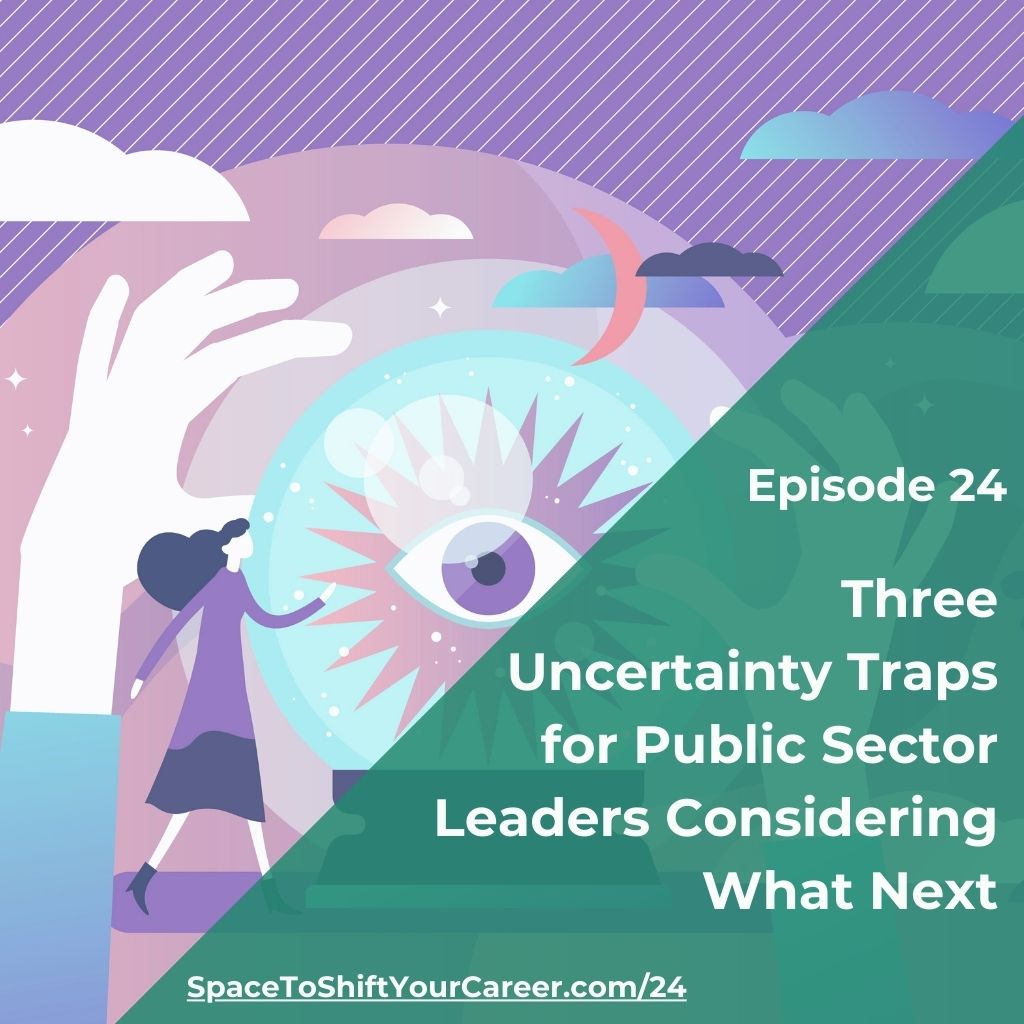
Many leaders believe they need to have all the answers before they move. They long for the crystal ball that’ll show them the future.
But in reality, most fulfilling careers are discovered through exploration, not prediction. You often can’t imagine your ideal role until you’re doing elements of it. Insights emerge through projects, conversations, side roles, and experiments. Testing ideas.
Clarity is rarely a thinking exercise alone. It’s a lived experience.
Career Change Is Not a Crisis – It’s a Transition
I remind my clients of this all the time: Career change is a lot more common than you might think. And it’s something to celebrate.
It’s an opportunity to rewrite your story, evolve your impact, and realign your work with who you are now – not who you were 20 years ago.
So if you’re asking, “What am I going to do with my life?”
Try reframing it as: “What do I want to explore in my next chapter?”
That question is lighter. And it’s much more answerable.
Until next time: make space, rediscover you, and then take action.